I was born at 11:59 p.m. Which date?
Use the date shown in the record for the place of birth. If the record is unavailable, verify it before relying on a boundary-day result.
A date-only calculator · a near-midnight birth
Enter the complete Gregorian date recorded for the birth, not the date shown by a clock in your current city. Chinese Sign Finder accepts a date, not a time zone or hour. If you only have a timestamp, establish the date at the birthplace first. If the date or location is uncertain and the birth was near Lunar New Year, this tool cannot resolve that uncertainty for you.
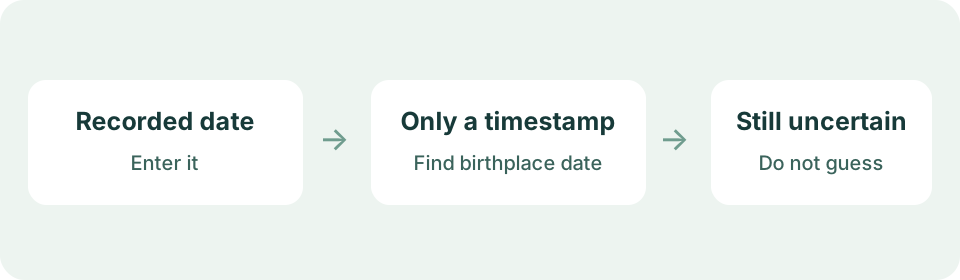
For U.S. birth registration, the CDC's facility worksheet guide records time of birth in 24-hour form, and its birth-registration handbook instructs staff to use local time. A change around midnight can therefore change the recorded date. Birth-record practices outside the U.S. may differ; use the document issued for your birth.
| What you have | What to enter or verify | What this tool knows |
|---|---|---|
| Gregorian date on a birth record | Enter that complete date | Which listed lunar year contains the date |
| Time stamp without local date | Determine the calendar date at the birthplace first | Nothing about time zones from the timestamp alone |
| Conflicting or uncertain records | Check the issuing record or ask its office | Cannot choose a date for you |
The Hong Kong Observatory's 2027 table places the first day of the Goat lunar year on February 6. In this site's date-only rule, a recorded February 5, 2027 date returns the preceding Horse year, while a recorded February 6 date returns Goat. The comparison shows why a one-day record difference matters here; it does not claim that an exact astrological transition can be determined from a date-only input in every location.
For the difference between Lunar New Year and Start of Spring, see the separate 2027 boundary comparison. This page addresses the date you type, not which boundary tradition to follow.
It has no birthplace, time zone, or birth-hour field. The Observatory's conversion tables provide its calendar dates; those dates are not a substitute for a location-aware chart. The Observatory also warns that some far-future lunar-month dates can differ by one day when the calculated new moon is close to midnight. That published caveat is another reason not to promise more precision than a date-only tool provides.
Use the date shown in the record for the place of birth. If the record is unavailable, verify it before relying on a boundary-day result.
This tool does not perform time-zone conversion. Entering an invented converted date would change the input, not make the result more certain.
The hour is not an input. See our birth-time scope guide for the difference between a year animal and hour-pillar questions.
We examined the calculator's actual input fields and date comparison, then contrasted two adjacent dates around the Observatory's 2027 Lunar New Year. The decision diagram, three-case table, and example are original. U.S. record guidance is cited for U.S. records only; no claim is made about every country's registration rules.