Same animal, different English word?
Goat, Sheep, and Ram can be labels for 羊. That wording alone is not a different animal-year calculation. See the 2027 naming comparison.
Result diagnosis · one date, different rules
First check what you entered and where each calculator starts its animal year. A year-only lookup, a complete birth-date lookup using Lunar New Year, and a method using Start of Spring can answer different questions. On this site, enter your complete Gregorian birth date: the animal changes on Lunar New Year's Day.
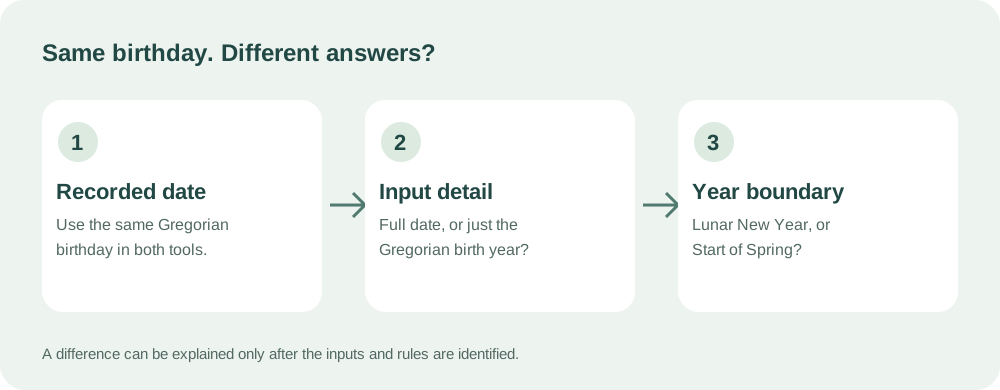
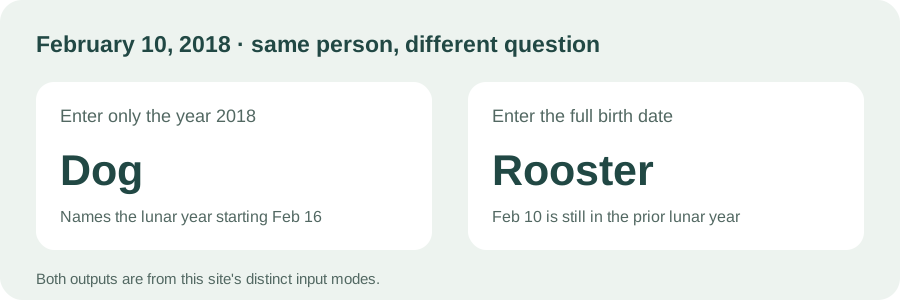
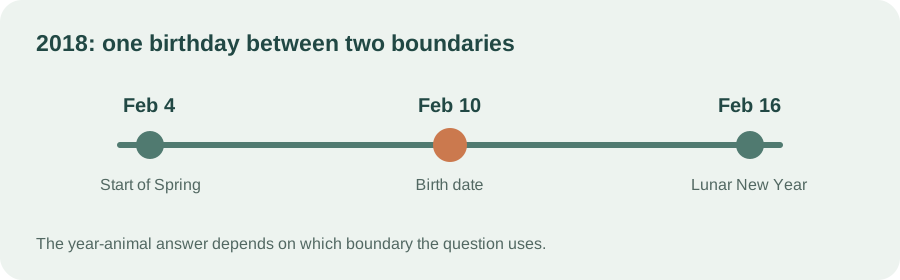
Take a recorded Gregorian birthday of February 10, 2018. The Hong Kong Observatory places Start of Spring on February 4 and Lunar New Year's Day on February 16 in 2018. Its 2017 and 2018 tables label the years Rooster and Dog respectively. These three answers follow from three different questions:
| Question or input | Rule applied | Animal returned | Why |
|---|---|---|---|
| “What animal year began in 2018?” | Year only on this site | Dog | The Dog lunar year began February 16. |
| “What lunar-year animal contains February 10?” | Full date on this site | Rooster | February 10 precedes the Dog lunar-year start. |
| “Which year follows the Start of Spring changeover?” | Start of Spring convention | Dog | February 10 follows February 4. This is a comparison of conventions, not a function of this calculator. |
The first two rows were checked against this site's calendar rows and date-selection rule. The third row applies the separate Start of Spring convention described by the Hong Kong Observatory; it does not claim that every other calculator implements that convention correctly.
This original short walks through the example date, both boundary dates, and the three checks to make before comparing results.
Goat, Sheep, and Ram can be labels for 羊. That wording alone is not a different animal-year calculation. See the 2027 naming comparison.
This site's year-animal result uses a date, not a birth hour. It does not calculate an hour pillar, historical time-zone conversion, daylight-saving rules, or true solar time. See the birth-time scope guide.
No. A different question or declared boundary can produce a different answer. If both tools claim the same date and rule yet disagree, compare the published calendar date and their actual outputs; the discrepancy remains unresolved until checked.
This calculator supports Gregorian birth dates from January 1, 1902 through December 31, 2030. Dates outside that range need another verified source; the calculator does not return a result for them.
The Observatory's 2018 conversion table identifies the February 4 solar term, February 16 first lunar day, and Dog year; its 2017 table identifies the preceding Rooster year. The Observatory's year-changeover explanation documents why the two boundary conventions appear. The February 10 comparison, three-question table, and diagnostic illustration are original applications to this site's documented implementation. No claim is made about a named competitor's live output.